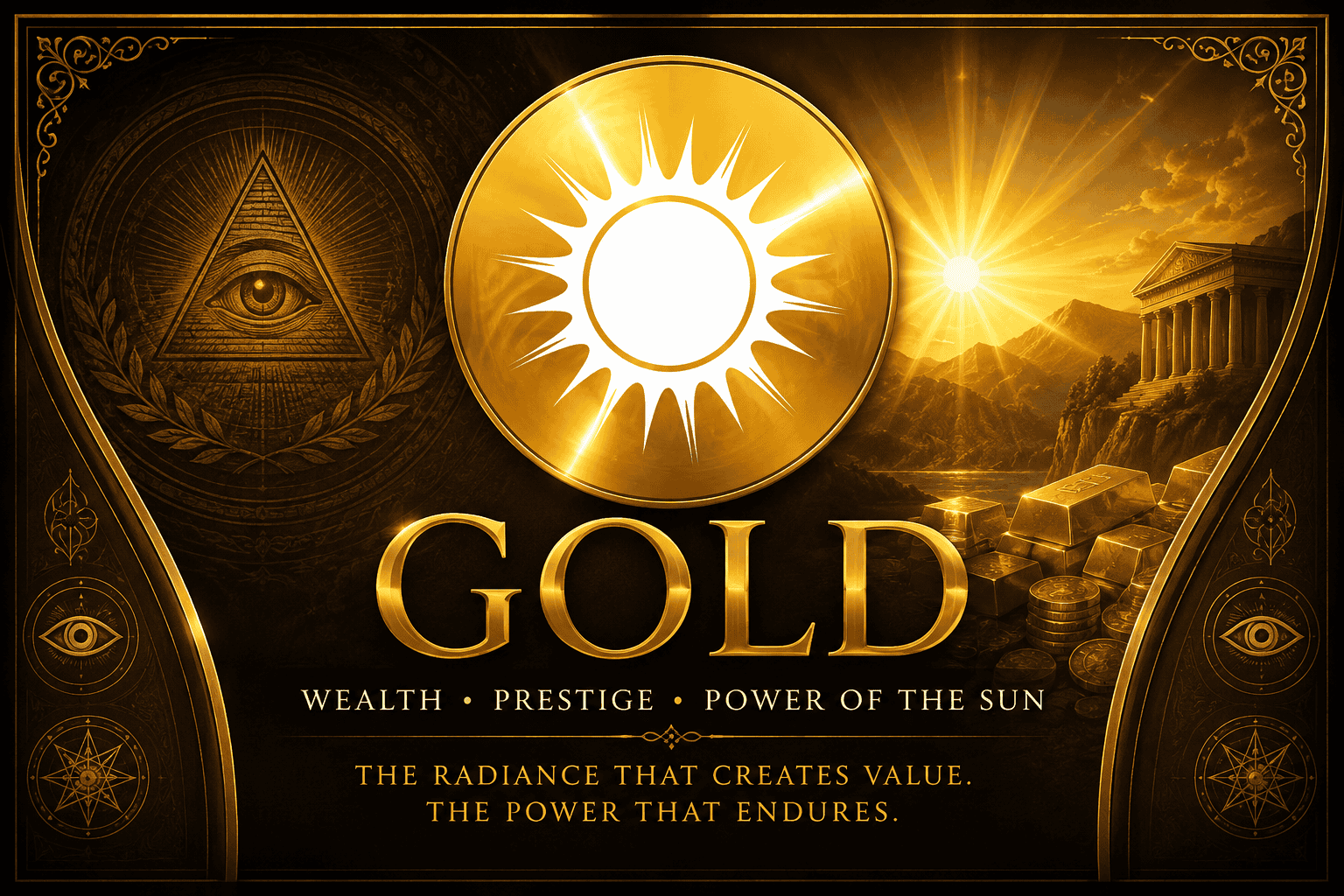

Wealth, Prestige, Power of the Sun
Throughout human history, gold has occupied a unique place in the imagination of humanity. Its rarity, resistance to corrosion, unmistakable color, and ability to reflect light have made it a powerful symbol of wealth, authority, prestige, and permanence.
Across different civilizations, gold has also been associated with the Sun. Its brilliant appearance and enduring nature have made it a natural symbol of light, power, and the divine.
Within the symbolic tradition presented by Ewiges Auge, gold represents the power of the Sun—the great illuminator whose light gives energy and life to the world.
Gold and the Power of the Sun
Gold possesses a color unlike most other metals.
It shines.
It reflects.
It appears to contain light within itself.
For ancient civilizations, this extraordinary appearance naturally connected gold with the Sun. Across different cultures, rulers and religious figures used gold to communicate power, sacred status, wealth, and permanence.
This is why gold has become more than a metal.
It has become a symbol.
Within the philosophy of Ewiges Auge, the symbols gold represents the radiance of the Sun and the human desire to transform effort into something of lasting value.
Gold Represents Wealth and Prestige
Gold has been treasured for thousands of years because it combines scarcity with remarkable physical properties.
It does not easily decay.
It can be shaped into intricate objects.
It can be polished until it reflects light brilliantly.
And because naturally occurring gold is relatively scarce, societies have repeatedly assigned significant value to it.
Gold has therefore appeared in crowns, jewelry, religious objects, ceremonial items, coins, and other representations of authority.
Its connection with wealth is not accidental.
Gold became valuable because human beings recognized its rarity and usefulness, while societies developed systems for exchanging and storing value through precious metals.
For centuries, monetary systems even incorporated gold directly. The gold standard connected currencies to specified quantities of gold and played an important role in international monetary history.
Gold Is More Than a Stone
At its most basic level, gold is a naturally occurring element.
It has no voice.
It has no desires.
It cannot decide whether it will be used for good or for harm.
Its meaning comes from humanity.
This is one of the deeper lessons contained within the symbols gold.
A piece of gold does not determine what happens after it enters human hands.
A person does.
Gold can become a wedding ring.
It can become a work of art.
It can become a scientific component.
It can become currency or an investment.
It can become a symbol of authority.
Or it can become an instrument of greed.
The metal itself remains unchanged.
The intention of the person using it determines what it represents.
Wealth Creates Responsibility
Within the philosophy of Ewiges Auge, wealth is not presented merely as a reward.
It is also a responsibility.
The more resources a person possesses, the greater their ability to influence the lives of others.
A wealthy person can build.
A wealthy person can invest.
A wealthy person can create employment.
A wealthy person can support education, scientific research, humanitarian projects, or communities in need.
But wealth can also be used selfishly.
This creates an important principle:
Possessing wealth is not the same as using wealth wisely.
Money and resources become meaningful through the actions of those who control them.
Gold therefore becomes a test of character.
It asks a simple question:
What will you do with what you possess?
Gold Has Inspired Creation and Conflict
Human history demonstrates that gold has inspired both extraordinary creation and devastating conflict.
The desire to possess gold has influenced exploration, trade, conquest, political power, and economic development.
The same material can therefore represent two completely different human impulses.
Creation.
And destruction.
Generosity.
And greed.
Freedom.
And domination.
Gold does not choose between them.
Human beings do.
The Power of Belief
Gold also reveals something fascinating about value itself.
Why should a small piece of yellow metal possess such extraordinary economic and symbolic importance?
Part of the answer is scarcity.
Part is durability.
Part is physical beauty.
But another part is collective belief.
Human societies agree that gold is valuable.
That agreement allows gold to function as a store of value and, throughout history, as a medium of exchange.
Modern money provides an even clearer example of this principle. Unlike commodity money, modern fiat currencies derive their value largely from legal frameworks, economic systems, and public confidence rather than from the physical material from which the currency is made.
Gold therefore reminds us that value is not always something that exists independently of humanity.
Sometimes value is created by what humanity collectively believes something represents.
Gold and the Sun
The relationship between gold and the Sun is among the oldest symbolic connections associated with the metal.
Gold’s brilliant color resembles sunlight.
Its resistance to decay suggests permanence.
Its rarity makes it appear precious.
And its reflective surface creates the impression that it contains its own light.
Ancient cultures repeatedly incorporated these qualities into religious and ceremonial traditions.
Within Ewiges Auge’s symbolic framework, the Sun represents illumination, energy, and revelation.
Gold becomes its earthly reflection.
The Symbols Gold
The symbols gold can therefore be understood through several interconnected ideas:
- Wealth — the material representation of accumulated value.
- Prestige — a visual expression of status and accomplishment.
- Power — the influence that resources can provide.
- The Sun — illumination, energy, and the source of light.
- Permanence — the ability of gold to endure through time.
- Responsibility — the obligation to use wealth wisely.
Each meaning leads naturally to the next.
Wealth can create power.
Power can create responsibility.
Responsibility can create positive change.
And positive change can become a lasting legacy.
Gold and Human Achievement
Gold can also represent the results of human effort.
A person earns wealth by exchanging time, knowledge, creativity, labor, or resources for something of value.
In this sense, gold becomes symbolic rather than merely material.
It represents the accumulated result of what a person has accomplished.
But achievement should not end with accumulation.
The greater question is what happens afterward.
What will you build with your success?
Who will benefit from your accomplishments?
What will remain after your wealth is gone?
These questions transform gold from a symbol of possession into a symbol of responsibility.
Gold Through the Ages
Kingdoms have risen.
Empires have fallen.
Borders have changed.
Currencies have disappeared.
Rulers have been forgotten.
Yet gold has continued to fascinate humanity.
Its physical properties have allowed it to survive many of the civilizations that once prized it.
Gold has passed through the hands of kings, merchants, governments, artisans, investors, and ordinary people.
The people change.
The civilizations change.
The meaning evolves.
But the fascination remains.
Gold as a Symbol of Responsibility
Within the broader symbolic system of Ewiges Auge, gold connects naturally with other symbols such as the Pyramid, Eye, Light, Eternal Circle, and Obelisk.
Each represents a different concept.
Gold represents value.
The Pyramid represents structure and progression.
The Eye represents awareness.
The Light represents illumination.
The Eternal Circle represents continuity.
Together, they create a philosophical language through which human ambition, knowledge, power, and responsibility can be explored.
The Gold Illuminati Talisman
Within the tradition presented by Ewiges Auge, real gold is used to create the Gold Illuminati Talisman, described as a symbolic object associated with members who have dedicated themselves to the advancement of humanity.
This should be understood as part of the site’s symbolic and narrative tradition rather than as independently verified evidence of a present-day organization or membership practice.
The symbolism itself remains consistent with the broader meaning of gold.
The talisman transforms the metal from a representation of material wealth into a reminder of responsibility.
Gold is valuable.
But the person who possesses it must decide what that value will accomplish.
What Will Your Gold Create?
The greatest lesson of the symbols gold is not simply that gold represents wealth.
It is that wealth gives people choices.
You can use resources to build or destroy.
To exploit or empower.
To accumulate or contribute.
To create fear or opportunity.
The metal cannot make that decision for you.
Only you can.
Gold has inspired wars and treaties.
It has funded kingdoms and revolutions.
It has adorned temples and crowns.
It has become currency, jewelry, art, technology, and investment.
But through every transformation, one truth remains:
Gold does not possess morality. The people who use it do.
The Power of the Sun
Gold ultimately represents something greater than material wealth.
It represents the light that humanity has pursued throughout history.
The Sun rises without asking who deserves its warmth.
It illuminates the wealthy and the poor.
The powerful and the powerless.
The wise and the ignorant.
Its light is given without discrimination.
Within Ewiges Auge’s philosophy, gold serves as a physical reminder of this greater Light.
Possess wealth, but do not allow wealth to possess you.
Seek power, but understand the responsibility that accompanies it.
Pursue success, but remember the people who helped make your success possible.
And when you finally possess more than you need, remember that the greatest value of wealth may be what you are able to create with it.
Wealth. Prestige. Power. Responsibility. Gold reflects the Light—but humanity decides where that light shines. ▲
0 Comments