
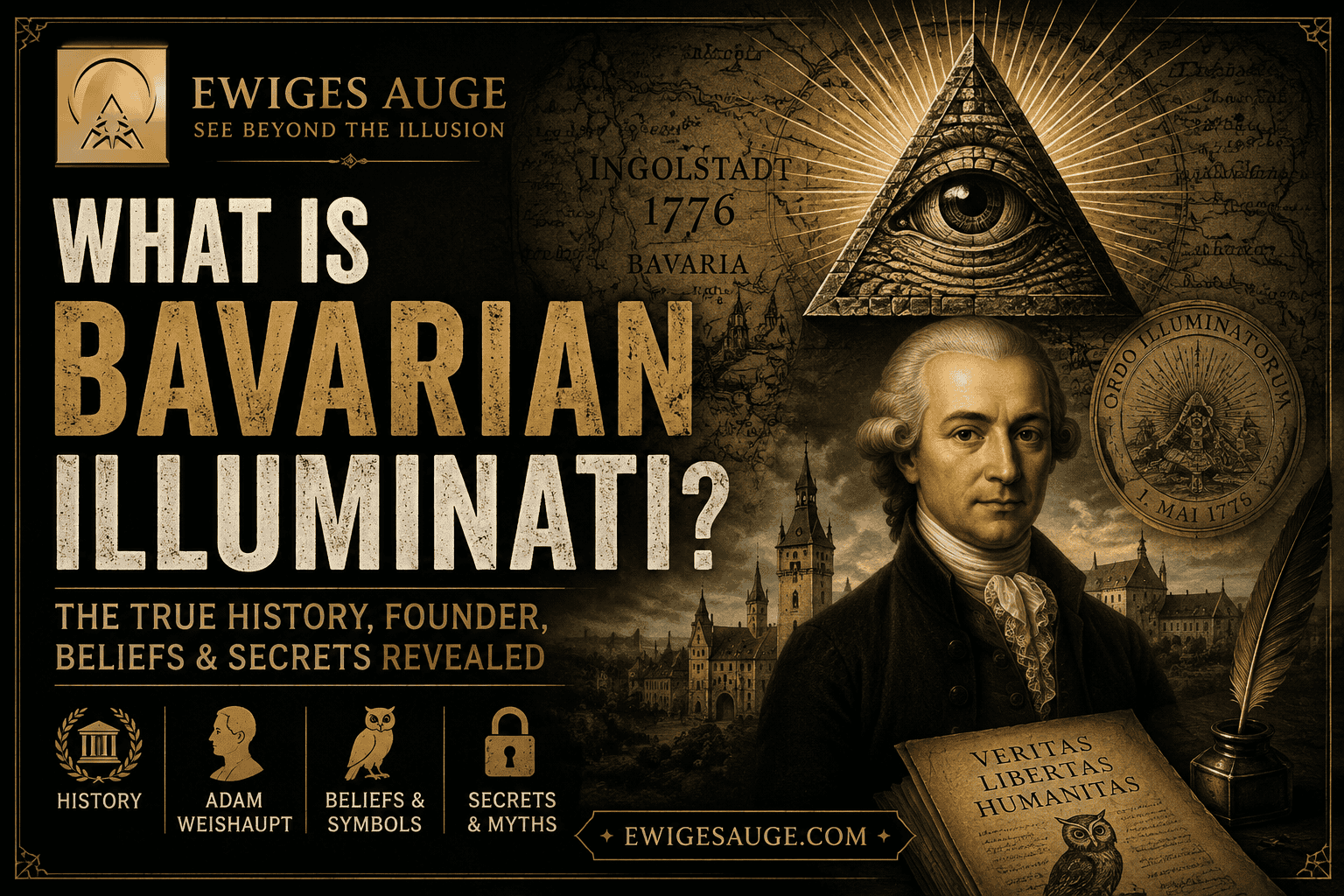

What Is the Bavarian Illuminati? History, Founder, and Legacy
The Bavarian Illuminati was a real secret society—but its documented history is very different from the global conspiracy mythology that later grew around its name.
The Bavarian Illuminati was founded in Ingolstadt, Bavaria, on 1 May 1776 by Adam Weishaupt, a professor of canon law and a thinker shaped by the European Enlightenment.
Its history is often hidden beneath centuries of speculation. Today, the word Illuminati can call to mind secret governments, hidden wealth, celebrity symbolism, and unseen control. Yet the historical organization was a small, short-lived society formed in a particular time and place.
To understand the Bavarian Illuminati, it is important to separate what history can show from what later legend has imagined.
The beginning of the Bavarian Illuminati
Adam Weishaupt founded the group with a number of senior students in Ingolstadt. Its earliest members called themselves the Perfectibilists before the organization became known as the Illuminati—a name derived from the Latin word illuminatus, meaning “enlightened.” LMU Munich’s historical account records both the 1776 foundation and the group’s early name.
The society emerged during the Enlightenment, when many European thinkers placed new importance on reason, education, intellectual freedom, and the questioning of inherited authority.
Weishaupt believed that knowledge could change society. He imagined a disciplined network of educated people who would develop themselves morally and intellectually, then carry those ideals into the wider world.
The organization was secret, but its purpose was not merely secrecy. It was built around the belief that ideas could shape human conduct—and that education could become a force for reform.
Who founded the Bavarian Illuminati?
The founder was Johann Adam Weishaupt, born in 1748. He taught at the University of Ingolstadt and became known within the order by the name Spartacus.
Weishaupt was not simply trying to establish a social club. He sought to create a structured circle of members committed to study, self-improvement, and the advancement of Enlightenment ideals.
That ambition gave the organization its strength, but it also gave it complexity. The Illuminati was built on a hierarchy, private communication, and carefully controlled membership. It valued independent thought while also demanding loyalty and discipline from those who joined.
The tension between freedom and structure is part of what still makes the organization interesting today.
What did the Bavarian Illuminati believe?
The historical Bavarian Illuminati was influenced by ideas connected with:
- Reason and critical thought
- Education and intellectual development
- Moral self-improvement
- Opposition to superstition
- Social reform
- Questioning excessive political and religious authority
These ideas must be understood within the world of eighteenth-century Bavaria. The order was not a modern political movement, nor was it the all-powerful global force described in later conspiracy stories.
Its members believed that people could become more capable through knowledge, discipline, and reflection. In that sense, the original organization was concerned with the transformation of the individual as much as with the transformation of society.
Why was the Bavarian Illuminati secret?
Secrecy was central to the order’s identity.
In eighteenth-century Bavaria, openly challenging established authority could bring serious consequences. The Illuminati therefore used aliases, private letters, ranks, and controlled recruitment to protect its members and its ideas.
Early levels within the order included Novice, Minerval, and Illuminated Minerval. As the group expanded, its internal system became more elaborate.
But secrecy alone does not prove extraordinary power.
A hidden organization can be historically real without secretly directing governments, revolutions, or world events. This distinction matters when looking at the Bavarian Illuminati, because the documents that survive show an organization with ambitions and internal structure—not proof of global control.
The Bavarian Illuminati and Freemasonry
The Bavarian Illuminati and Freemasonry were separate organizations, though they became connected through overlapping members and networks.
Weishaupt joined a Masonic lodge in 1777, and the Illuminati later built relationships with Masonic circles. Baron Adolph von Knigge became especially important in helping the order expand and refine its structure.
Those connections contributed to later claims that Freemasonry and the Illuminati were parts of one worldwide secret organization. History, however, requires a more careful view.
The two groups shared some members and social connections, but they were not identical. Their relationship is an example of how overlapping networks can later become the foundation for much larger stories.
What happened to the Bavarian Illuminati?
The order did not last long.
Internal disagreements weakened it, while Bavarian authorities became increasingly suspicious of secret societies. The group was banned during 1784 and 1785, and its documents and correspondence were seized and published. German History Intersections notes that the organization was mainly active in Bavaria and banned in 1784/85.
The suppression of the order did not end its influence on popular imagination. In many ways, it began a new chapter.
After the Bavarian Illuminati disappeared from open historical activity, writers and political opponents began attaching its name to events far beyond its documented reach. The French Revolution, Freemasonry, banking, governments, and secret power all became part of a growing mythology.
The historical order was short-lived. Its legend was not.
Did the Bavarian Illuminati control the French Revolution?
There is no established historical evidence that the Bavarian Illuminati secretly directed the French Revolution.
The Revolution was shaped by political conflict, economic hardship, class tension, intellectual change, and the collapse of trust in the French monarchy. Reducing such a vast event to one hidden organization ignores the complexity of history.
The claim that the Illuminati controlled the Revolution became popular after the order had already been suppressed. It shows how secrecy can invite speculation—and how speculation can become more powerful than the original facts.
Symbols: the Owl, the Eye, and the Pyramid
The historical Bavarian Illuminati is associated with the Owl of Minerva, an ancient symbol of wisdom and learning.
The Eye and the Pyramid, by contrast, became more strongly connected with the modern image of the Illuminati through later art, political imagery, popular culture, and conspiracy traditions. These symbols can carry many meanings: knowledge, awareness, vision, protection, hierarchy, endurance, and the search for hidden truth.
A symbol does not prove a direct historical connection on its own. Meaning changes as symbols travel across cultures and generations.
Explore the symbolism further:
Bavarian Illuminati vs. modern Illuminati claims
| Historical Bavarian Illuminati | Modern Illuminati mythology |
|---|---|
| Founded in 1776 | Often portrayed as timeless or still active |
| Founded by Adam Weishaupt | Often attributed to an unnamed global elite |
| Based primarily in Bavaria | Often said to control the world |
| Historical members and letters are documented | Alleged members are generally unverified |
| Banned in the 1780s | Often claimed to have continued without interruption |
What can we actually know?
The Bavarian Illuminati was real. Adam Weishaupt founded it in Ingolstadt in 1776. It was shaped by Enlightenment ideas, organized in secret, connected in part with Masonic networks, and suppressed by Bavarian authorities during the 1780s.
What came afterward is more difficult to separate.
The name Illuminati became a vessel for questions people have always asked: Who holds power? What influences society? What is hidden from view? Can knowledge change the world?
Those questions are larger than any one organization. They are part of humanity’s enduring search for truth, meaning, and influence.
The Bavarian Illuminati may have belonged to the eighteenth century, but its legacy continues because secrecy, symbolism, and hidden knowledge still hold a powerful place in the human imagination.
Frequently asked questions
Was the Bavarian Illuminati real?
Yes. It was a real secret society founded by Adam Weishaupt in Ingolstadt, Bavaria, in 1776.
Who founded the Bavarian Illuminati?
Adam Weishaupt, a professor of canon law and Enlightenment thinker, founded the organization.
When did the Bavarian Illuminati end?
It was banned by Bavarian authorities during 1784 and 1785 and did not remain an openly documented organization afterward.
Did the Bavarian Illuminati control the world?
There is no reliable historical evidence that the original Bavarian Illuminati controlled world events, governments, or financial institutions.
What symbol was associated with the historical Bavarian Illuminati?
The Owl of Minerva is historically associated with the order and traditionally represents wisdom.
Further reading
University of Erfurt: New research on the Order of the Illuminati
LMU Munich: 1776—Foundation of the Illuminati
German History Intersections: Two Letters from Adam Weishaupt



0 Comments